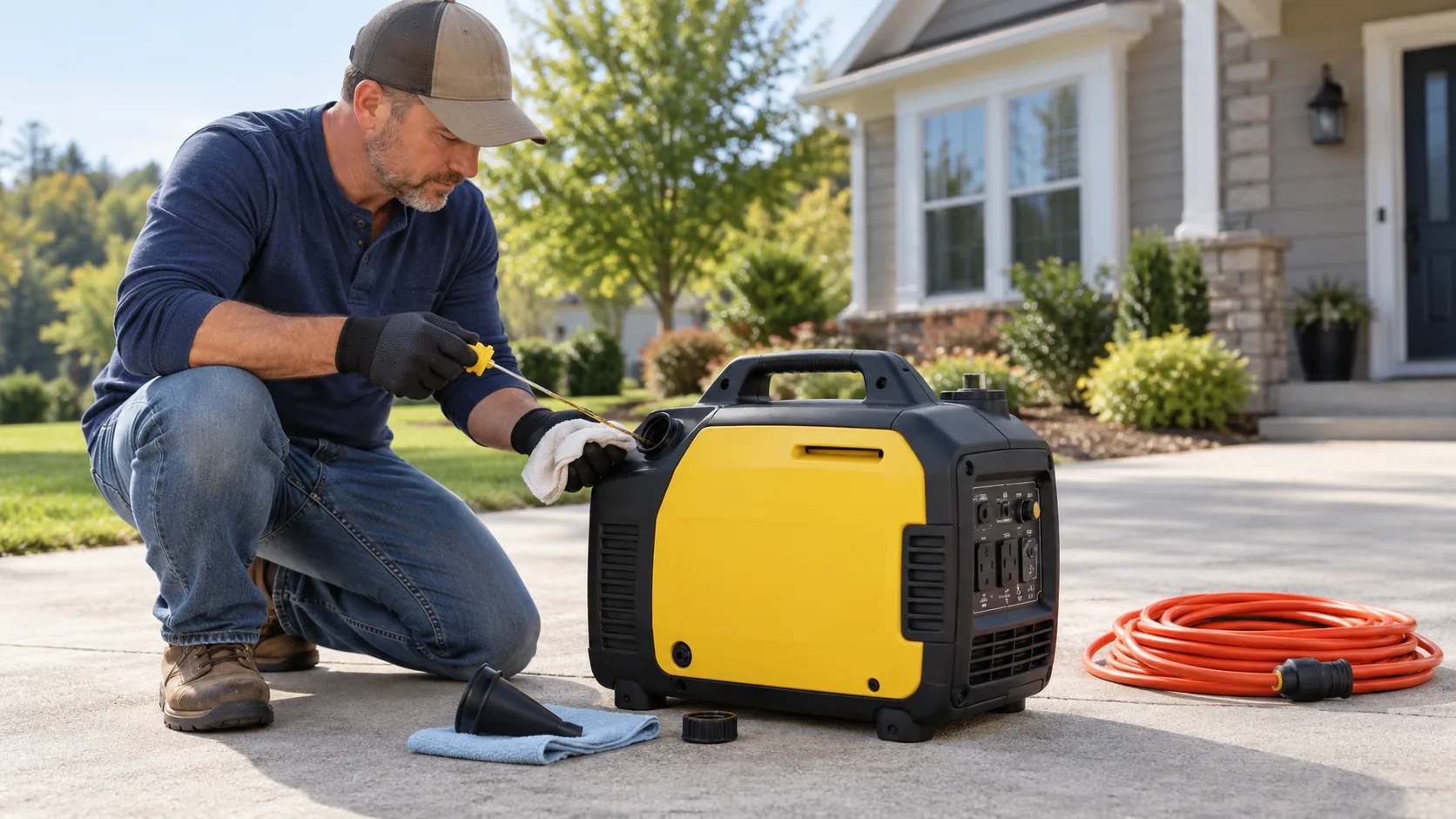
A portable generator has an easier idle life than a whole-house standby unit and a harder job once it's running. It's usually fueled and started by hand, connected with cords or a manual transfer setup, and asked to work after months of sitting in a garage or shed. That mix of infrequent use and hand-fueling is what breaks portable generators when an outage finally arrives. It's a different failure pattern than the one a standby generator's maintenance schedule is built around.
The portable-generator rhythm: break-in, running fuel, and idle storage
| Trigger | What to do | Why it sits here |
|---|---|---|
| Before each use | Check oil as the manual directs; look for fuel or oil leaks, blocked air intake, damaged cords, and safe outdoor placement. | A quick pre-start check can reveal damage after storage or transport. |
| Break-in period | Change oil only at the run-hour point listed in this exact model’s manual. | Break-in hours and first service requirements vary by engine. |
| Operating hours / calendar interval | Use the oil, filter, air-cleaner, spark-arrester, and plug intervals in the owner’s manual; log engine hours. | The manufacturer’s schedule controls, including whichever comes first if it lists both time and hours. |
| Before long-term storage | Follow the manual for draining fuel or using stabilizer; keep the unit upright, cool, and in a ventilated storage area. | Gasoline storage steps and allowed stabilizer period depend on fuel system and model. |
| Before storm season | Perform the manual’s readiness checks and test the generator only in a safe outdoor setup. | Find faults before an outage, while repair support is available. |
What to check every time you start it
- Oil level, checked on level ground with the engine off.
- Fuel level, plus any leak or varnish smell.
- Cords and plugs, for cracked insulation or bent prongs.
- The air intake and muffler area, clear of leaves and debris.
Let the engine cool before you refuel. Spilled gas near a hot muffler is how a routine outage turns into a fire.
Oil grade, the spark arrestor, and the battery
Use the oil grade and service intervals in your model's manual for the expected temperature range. Fuel-system storage instructions also differ across carbureted, fuel-injected, dual-fuel, and propane models; do not assume a single 30-day rule.
Clean the muffler screen called a spark arrestor when the engine is cool, since carbon clogging shows up as weak power. On electric-start units, keep the battery on a maintainer so it turns over when the outage hits.
Signs it needs attention before the next outage, not during it
- Starts hard, stalls, or surges even though the fuel is fresh.
- An extension cord or plug feels warm to the touch under load.
- Fuel smells stale or varnished rather than sharp.
- Electric start is sluggish, or the battery won't hold a charge between monthly tests.
| Gasoline model | Propane-only or dual-fuel | |
|---|---|---|
| Storage concern | Ethanol-blended gasoline can degrade and gum the carburetor. | Propane avoids the stale-gasoline problem described. |
| Planning action | Use stabilizer or run the tank dry per the manual. | Follow the model’s storage and fuel instructions. |
| Record | Log stabilizer or dry-run date. | Log service and test history. |
Fuel is the part standby owners don't have to think about
A permanently installed standby generator usually runs on natural gas or a large propane tank, so fuel simply doesn't age the way it does in a portable unit's small gas tank. Ethanol-blended gasoline left sitting for weeks absorbs moisture and starts to break down. The residue it leaves behind can gum up a small carburetor badly enough that the repair costs more than a season's worth of stabilizer would have. If you only run the unit a few times a year for testing, treat every tank as if it has to last exactly one use. Add stabilizer at the start, or plan to burn the tank down and run the carburetor dry before the generator goes back into storage.
Dual-fuel and propane-only portable models sidestep the stale-gas problem almost entirely, since propane doesn't degrade in storage the way pump gas does. That's worth factoring in if you're shopping for a unit specifically for infrequent, disaster-only use instead of routine power-tool duty around the property.
Run the unit outdoors, away from doors, windows, and vents. Never use it in a garage, even with the door open. Keep working smoke and CO alarms inside.
Carbon monoxide risk is higher, not lower, because it's portable
Portable generators can produce lethal carbon monoxide. Run one outdoors, far from doors, windows, and vents, and follow CPSC placement guidance and the product manual. A carbon-monoxide shutoff feature is an added safeguard, never a substitute for safe outdoor placement.
Working smoke and CO alarms inside the house remain the backup layer. Placement outside, away from every opening the house has, is still what keeps carbon monoxide from becoming the story.
Connecting to the house: cords, interlocks, and the mistake that hurts utility workers
Use a heavy, outdoor-rated extension cord sized for the load; a light-duty household cord will overheat and can start a fire well before it ever trips a breaker. For running the whole house through the electrical panel instead of a handful of individual cords, homeowners generally choose between an interlock kit and a transfer switch. An interlock is a mechanical block added to the panel that only lets the main breaker or the generator breaker be on at once. A transfer switch does the same job with dedicated wiring and, in automatic versions, no manual step at all. Either one has to match your specific panel model to pass inspection and work safely, which makes this an electrician's job rather than a weekend project.
Never plug a generator directly into a household wall outlet to power circuits backward through the panel. That practice, sometimes called backfeeding, can energize the utility lines outside your house at lethal voltage for any lineworker repairing the very outage you're trying to ride out.
Keep hours run, oil-change dates, the date you last added stabilizer, and the date of the last loaded test run in one place near the unit. That record tells you whether a hard start next winter is a fuel problem, an overdue oil change, or an actual mechanical fault. Without it, you're guessing from memory after eight months in storage.
Portable generator questions
How often should I start and run my portable generator when there's no outage?
Follow the exercise instructions in the owner’s manual. Some manufacturers recommend periodic runs, while the runtime, load, and preparation differ by model; never run it indoors or in a garage, even with a door open.
Is fuel stabilizer really necessary for a generator I only run a few times a year?
Follow the fuel-system storage directions for your model and fuel. The allowed storage time and whether to drain, run dry, or use a stabilizer vary; if stabilizer is specified, follow its label and the generator manual.
Do I need a transfer switch, or is an interlock kit enough?
Both prevent the dangerous mistake of backfeeding power into utility lines. The real difference is cost and convenience instead of safety, as long as either one is installed correctly and matched to your panel. An interlock kit is the cheaper, simpler option and still requires manual switching. A transfer switch, especially an automatic one, costs more but can shift the house onto generator power with little or no manual action. Have an electrician confirm which option fits your specific panel.