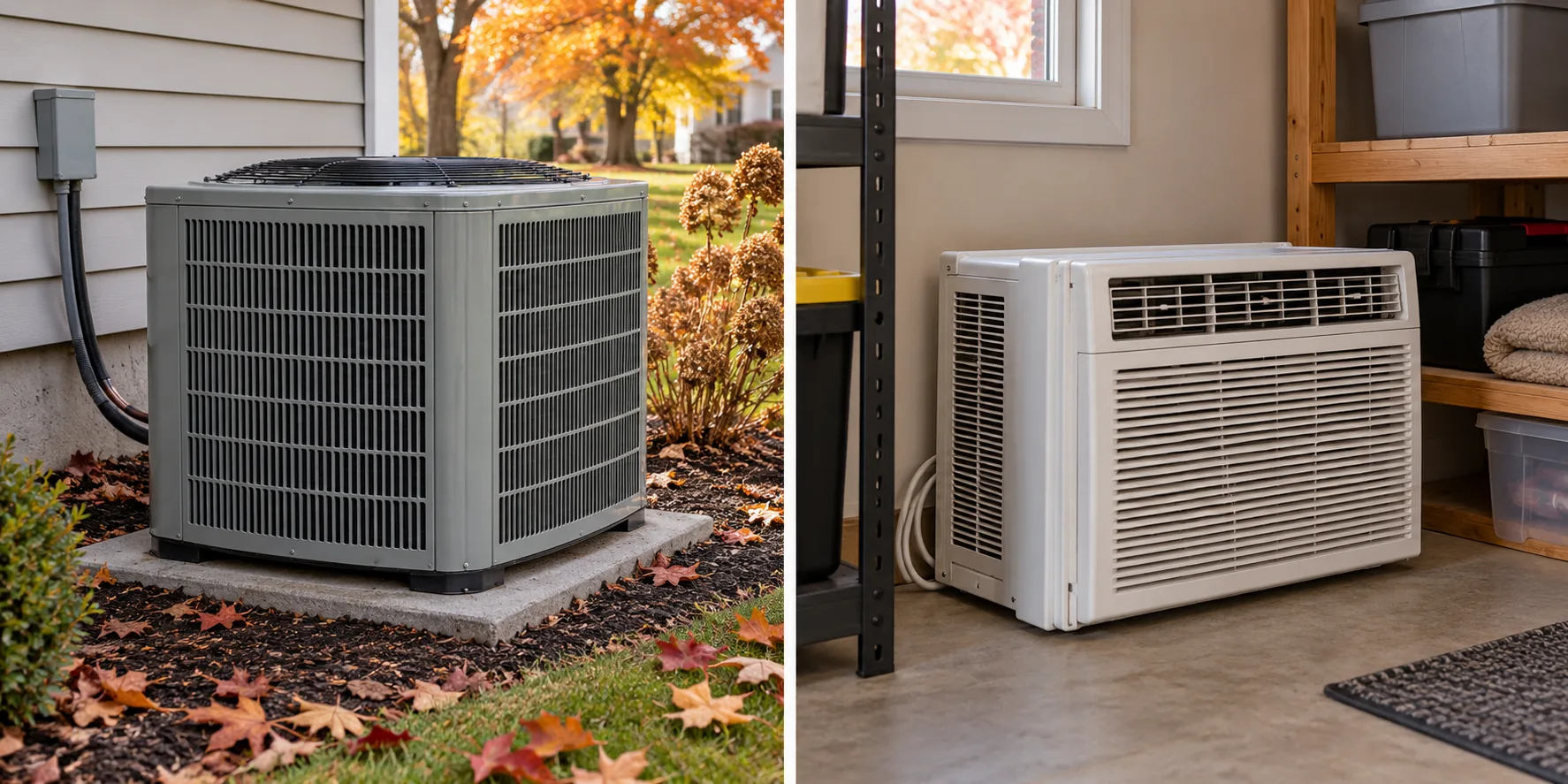
The instinct to wrap a central air conditioner in plastic for the winter is well-meaning and, for most homes, the wrong move. The unit already sits outside through every season and is built with drainage and materials meant to handle rain, snow, and freezing temperatures without help. The real risk heading into winter isn't the cold reaching the equipment; it's trapped moisture, blocked airflow, and a dry, dark space that local wildlife finds very appealing.
One check before you follow any of this. If the outdoor unit is a heat pump rather than a cooling-only air conditioner, it keeps running all winter to heat the house. It should not be covered at all, and the shutdown advice below does not apply to it. Look at the nameplate or your owner's manual if you aren't sure which one you have.
What the condenser and any window units need before cold weather
| Trigger | What to do | Why it sits here |
|---|---|---|
| End of cooling season | Clear leaves, mulch, and grass clippings from around and inside the base of the outdoor unit | Debris trapped against the coil over winter can corrode fins and block airflow once cooling season returns |
| Near trees or heavy leaf-drop | Trim branches back and consider a breathable top-only cover for the unit | A cover over just the top sheds falling debris without sealing in moisture the way a full wrap does |
| Once heating season is underway | Leave the condenser itself alone; no need to disconnect power or open the cabinet | Manufacturers build these units to sit outside and idle through winter without homeowner intervention |
| Window units you can remove | Take the unit out, drain any standing water, and store it indoors somewhere dry | Indoor storage avoids the freeze-thaw and moisture cycling a unit left in the window goes through all winter |
| Window units left in place | Install an indoor-and-outdoor insulated cover kit sized for the unit, or foam panels in the sleeve gap | A window unit is a hole in the wall with a thin metal box in it, and that gap is where winter drafts come from |
| Before the first freeze | Confirm any exposed drain hose from a window unit is disconnected and empty | A hose still holding water can freeze and split like an outdoor hose bib left connected |
| Full wrap | Breathable top cover | |
|---|---|---|
| Moisture | Can trap moisture against components. | Leaves the unit sides open for airflow. |
| Debris or snow | Blocks airflow around the entire unit. | Can shield from falling debris while leaving sides open. |
| Use described | Generally avoid. | Consider where tree debris or roof ice is a concern. |
Why a full plastic wrap usually backfires
Sealing a condenser in plastic sounds protective, but it creates a closed, humid microclimate right on top of electrical components and refrigerant lines that were designed to breathe. Condensation collects inside the wrap, has nowhere to evaporate to, and sits against metal parts through months of freeze-thaw cycling, which promotes rust and corrosion instead of preventing it. Mice and other small animals also treat a wrapped, undisturbed unit as an ideal winter shelter. A nest built against wiring or inside the cabinet is a far more likely spring problem than anything the cold itself would have caused.
If you do want some protection, such as heavy tree cover overhead, a spot that catches deep snow drifts, or an ice-prone roof edge above it, cover only the top of the unit. Use a breathable, purpose-made cover and leave the sides open so air keeps moving through the coil.
Window units: remove when you can, insulate when you can't
A window air conditioner that stays in place all winter is fighting the same battle as a poorly weatherstripped door. It's a gap in the building envelope that a rubber gasket and a thin cabinet were never going to seal perfectly. If the unit can physically come out, remove it and let it dry completely. Store it somewhere that won't see repeated freezing and thawing, which is hard on both the cabinet plastic and the compressor's internal lubrication.
When a unit is too heavy, too high, or too awkward to remove safely every fall, leave it in. An insulated indoor-and-outdoor cover kit, or foam panels cut to fit the sleeve gap, closes most of the draft without requiring you to handle the unit at all. Either way, check that the unit's own drain path is empty before temperatures drop. A trickle of leftover condensate is the kind of small amount of water that finds a crack to freeze into.
Signs to check before you close things up for the season
- Ice was forming on refrigerant lines during the last weeks of use.
- The outdoor unit vibrates, rattles, or grinds louder than it used to.
- Debris is already visibly packed into the coil fins.
- Standing water collects at the base instead of draining away.
Running cooling mode once it's genuinely cold isn't a good workaround
There is no one outdoor-temperature cutoff for every cooling system. Before running central cooling in cold weather, check the unit’s operating-temperature range and instructions; some systems need low-ambient controls or may not be designed to run below a stated temperature. Do not repeatedly cycle a system outside its published range.
Mild and humid climates change the calculus
In mild coastal or southern climates, where the condenser barely gets a real break between cooling seasons, skip the cover question entirely and focus on debris clearing. The trapped-moisture risk of any cover matters more in a climate that's already humid most of the year. In snow-load regions, a top-only breathable cover earns its keep more often, particularly under trees or near a roofline that sheds ice.
AC winterizing questions
Should I cover my central air conditioner for the winter?
Check the outdoor unit’s manual. A cooling-only condenser designed to remain outside generally needs clear airflow and drainage; if falling debris is a concern, use only a cover the manufacturer permits and keep the sides open. Never cover a heat pump that will operate during winter.
Can running my AC in cold weather damage it?
There is no one outdoor-temperature cutoff for every system. Check the unit’s published operating range and low-ambient instructions before running cooling in cold weather. Some systems need additional controls or are not designed for low outdoor temperatures. Avoid repeated operation outside the manufacturer’s stated range, and ask an HVAC technician if the manual is unclear.
What's the right way to protect a window air conditioner over winter?
Remove it if you can, after draining any standing water and letting it dry, and store it indoors somewhere it won't cycle through repeated freezing and thawing. If it has to stay in the window, use an insulated indoor-and-outdoor cover kit or foam panels in the sleeve gap to close the draft. Then confirm the drain path is empty before the first hard freeze.