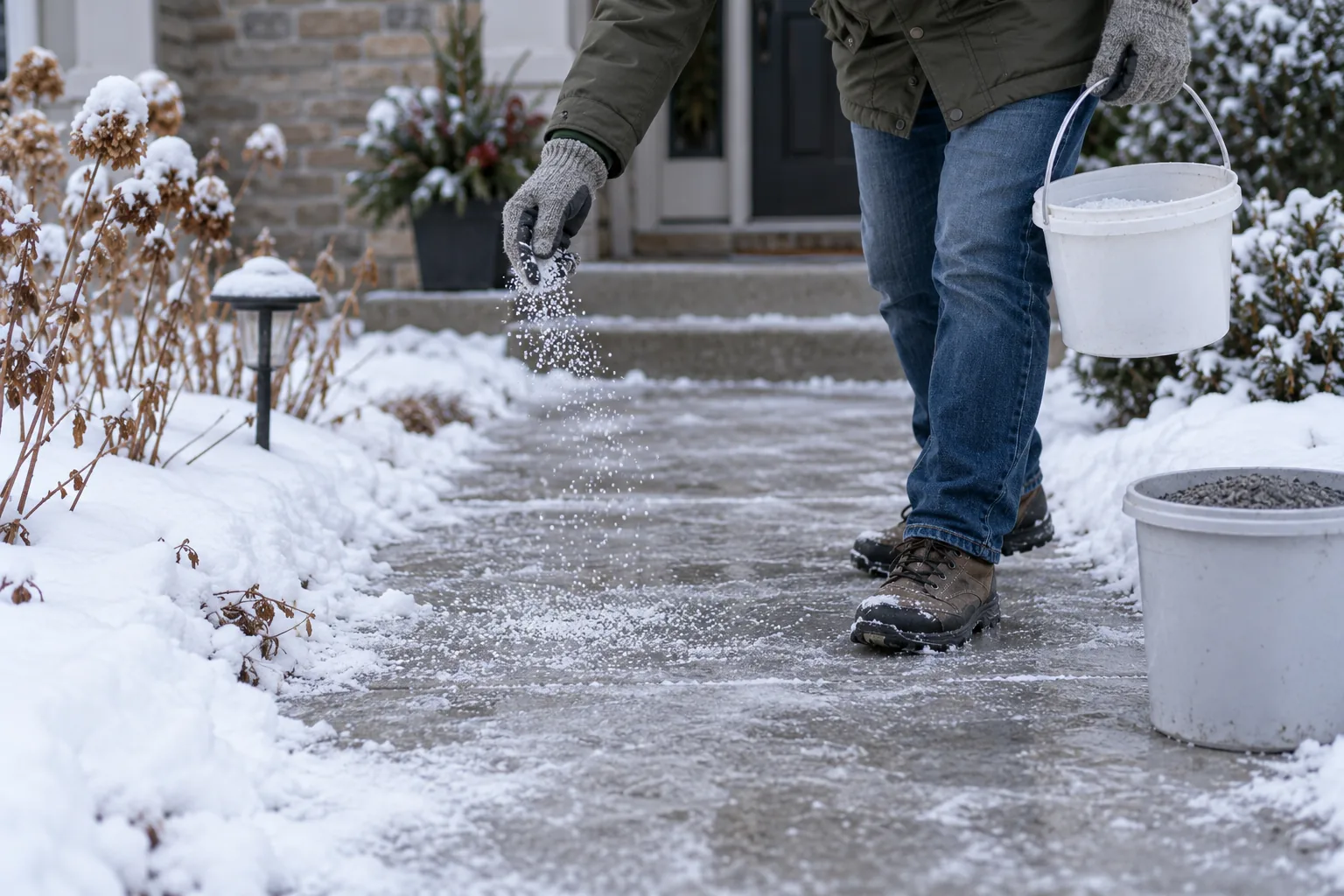
The ice melt bag nearest the store entrance in November isn't automatically the right one for your driveway. The common products work down to different minimum temperatures, carry different risk to concrete and plants, and are effective in very different quantities. Using the wrong one, or simply using too much of the right one, is how a routine winter task ends up pitting a driveway that was fine last year.
How the common ice melt types compare
| Material family | Cold-weather performance | Surface/environment trade-off | How to choose |
|---|---|---|---|
| Sodium chloride (rock salt) | Works best above about 15°F; performance falls in colder weather. | Chloride runoff can affect freshwater; salts can corrode metal and damage vegetation. | A low-cost option for suitable, cured surfaces in milder freezes; follow label rate. |
| Calcium or magnesium chloride | Often works at lower temperatures than sodium chloride; exact limit depends on formulation. | Still chloride salts; can corrode metal and affect plants, water, and concrete. | Read the exact bag’s temperature range and surface cautions; do not treat “stronger” as “safer.” |
| Calcium magnesium acetate (CMA) | Performance is formulation- and temperature-dependent; check the product label. | Can reduce some chloride-related corrosion, but still has environmental trade-offs and may cost more. | Compare label directions and runoff conditions before use. |
| Sand or traction grit | Adds grip but does not melt ice. | Can track indoors and wash into drains; sweep up after the thaw. | Choose when traction matters more than melting or conditions are below the deicer’s stated range. |
New concrete changes the answer
New or damaged concrete can be more vulnerable to scaling, especially through freeze-thaw cycles. There is no one age cutoff that makes every concrete mix safe for every deicer. Ask the installer about the surface’s cure and sealer, then follow the product label; when uncertain, remove snow mechanically and use traction grit while protecting the concrete from pooled water.
Shovel first. Apply only the amount on the product label, keep it away from plants and drains, and sweep up excess after thaw.
Less is more: application rate and timing
Shovel first, then apply only the amount stated on the specific product label. Different blends have different particle sizes and strengths, so a handful-per-square-yard rule can overshoot or underdose. If the label gives a spread rate, measure a small area once to learn what that amount looks like, and keep extra material off garden beds, metal, and storm drains.
Shovel first whenever you can. Remove the bulk of the snow or ice mechanically before you apply anything chemical. The deicer then only has to finish a thin layer, which is both cheaper and gentler on the surface underneath than expecting the product to do all the work by itself.
Signs you're using too much, or the wrong product
- White, crusty residue builds up on the concrete surface after it dries.
- The surface starts flaking, pitting, or scaling once the ice melts off.
- Pets hesitate to walk on treated areas or lick at their paws afterward.
- Grass or plants along the treated edge die back in a distinct strip.
Pet-safe labels and traction-only options
Treat claims such as “pet-friendly” as marketing until you check the ingredient and safety directions. Keep pets away while the material is being spread, store the bag out of reach, and wipe paws after walks on treated ground; ask a veterinarian if irritation or ingestion occurs.
If you only need grip, plain sand or a grit product adds traction at temperatures where melters stop working. It doesn't melt anything, and it tracks indoors and washes into drains, so sweep it up in spring.
Runoff goes somewhere, usually a storm drain
Deicing salt that washes off a driveway doesn't just disappear. It typically runs into a storm drain and from there into a local stream, lake, or groundwater supply. Chloride doesn't break down once it's in the water the way some other pollutants do. The EPA has flagged winter road-salt runoff as a water-quality concern in salted regions. It's the same chemistry playing out at a smaller scale on an over-salted driveway. Using the minimum effective amount isn't just about protecting your own concrete and lawn; it's the same habit that keeps chloride out of water supplies downstream.
Wipe a pet's paws after a walk on treated surfaces, since the residue that irritates skin is also what they'll lick off on their own. Store any deicer bag the way you'd store other chemical products around the house. Keep it closed, dry, and out of reach of kids and pets, instead of left open next to the porch steps all winter.
Metal stairs, railings, and car undercarriages take the same hit
Chloride deicers that track onto metal stair treads, railings, and door thresholds accelerate rust the same way road salt does on a car's undercarriage. Rinse or wipe down metal hardware near heavily treated walkways once temperatures allow. It's worth the five minutes it takes. Composite and wood decking generally tolerate the common ice melts better than bare metal does. Still, check manufacturer guidance before assuming any deicer is safe on a specific stair or railing finish. A quick rinse also keeps salt-laden slush from being tracked indoors onto tile or hardwood, which is its own kind of maintenance headache once winter is over.
Ice melt questions
What is a cautious option for newer concrete?
There is no universal age cutoff for all concrete and deicer blends. Ask the installer about the mix and sealer, follow the product label, and use shoveling plus traction grit if unsure. Avoid letting salty slush pool and refreeze on vulnerable concrete.
Is rock salt ever still the right choice?
Rock salt may be practical on compatible, cured pavement in milder conditions, but it loses effectiveness as temperatures fall and adds chloride to runoff. Compare the actual product label’s temperature range and surface cautions; calcium and magnesium chloride also carry corrosion and runoff trade-offs.
How much ice melt should I put down?
Shovel first and follow the spread rate on the particular bag. Formulations differ, so there is no dependable handful-per-square-yard dose for every product. Measure a small test area if the label gives a rate, and sweep up excess after conditions improve.